
Indoor vs Outdoor UV Exposure: When Should You Be Wearing SPF 50?
-
admin
- Posted on
- 0 comments
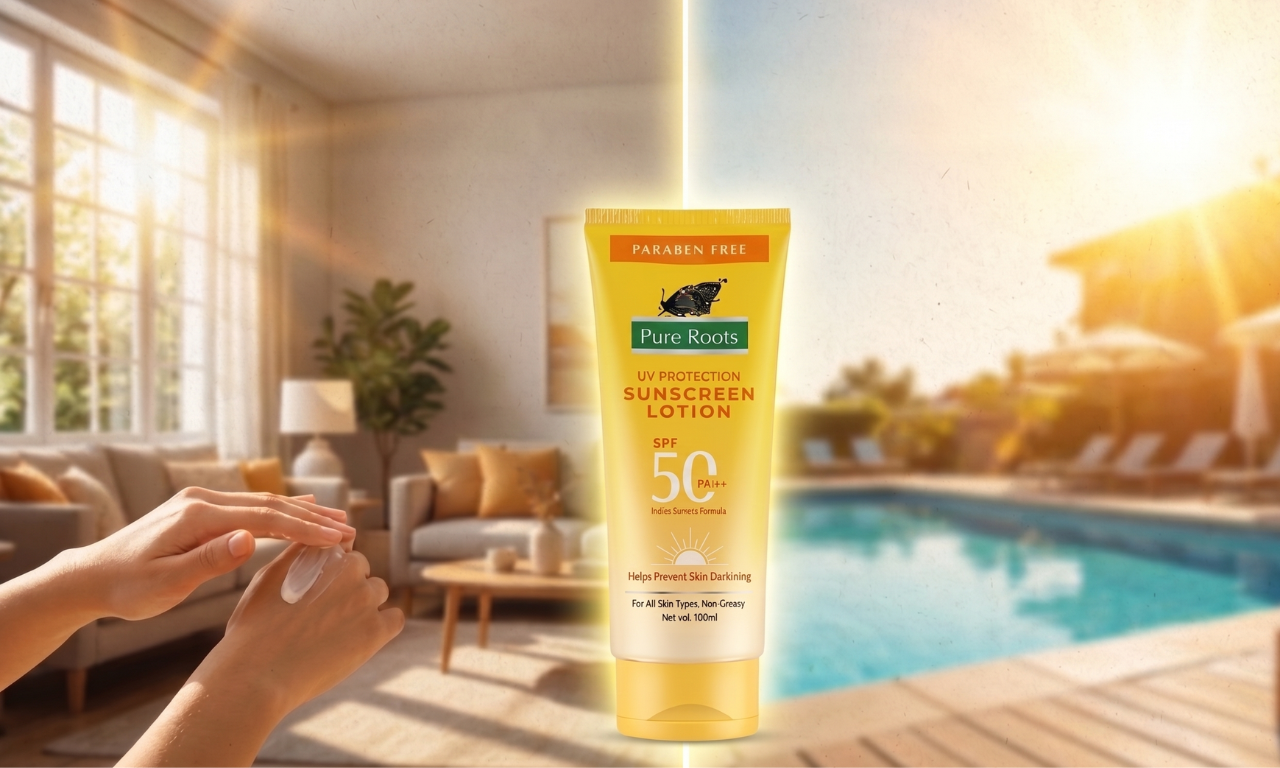
It’s tempting to think of sunscreen as an outdoor accessory – something you grab on your way to the beach or a long afternoon in the sun. If that’s your current habit, you are protecting yourself for only about 20% of your actual UV exposure and leaving the other 80% completely unprotected.
That’s not a scare tactic. That’s what the numbers show.
UV radiation doesn’t stop when you go inside. It follows you through windows, bounces off reflective surfaces and, in some instances, emanates from the screens and lighting around you. Knowing the difference between indoor and outdoor UV exposure is not just a fun little skincare fact, it’s the difference between a sunscreen habit that actually works and one that is mostly performative.
What UV Radiation Really Is (And Why SPF 50 Is A Thing)
Ultraviolet radiation is actually two types of light that matter to your skin: UVA and UVB.
Sunburn is caused by UV rays, specifically UVB rays. They are strongest around midday, change with the seasons, and are partly obstructed by glass. Your skin takes a real hit from UVB – redness, peeling, the classic beach burn.
The silent problem is UVA rays. They penetrate deeper into the dermis, work at a constant intensity all year round and at all times of the day, and pass through glass almost completely unfiltered. UVA is responsible for premature aging – fine lines, loss of elasticity and deep pigmentation. You won’t see the damage UVA causes, but over years it accumulates into changes that no amount of Vitamin C serum can completely reverse.
An SPF 50 UVA UVB protection sunscreen handles both. SPF 50 blocks about 98% of UVB rays (compared to 97% for SPF 30), and if it’s broad-spectrum or PA+++ it has good UVA protection too. That 1% difference in UVB blocking might sound trivial, but it is not for daily cumulative exposure over a period of months and years.
Indoor UV Exposure: The Unheard Story
This is where most sunscreen habits have a huge blind spot.
Window glass and UVA: Normal window glass blocks almost all UVB but allows up to 74% of UVA radiation to pass through. If you work at a desk near a window, spend more than 15 minutes a day in a car or hang out in any glass-fronted space you’re getting a meaningful dose of UVA, the type that ages skin without burning it. That’s why dermatologists who treat aging skin always note more pronounced pigmentation and texture changes on the side of the face facing a window.
Blue light from screens: The research in this area is still emerging, but the current evidence suggests that high-energy visible (HEV) light from laptops, phones, and LED lighting can contribute to oxidative stress in skin cells and potentially worsen pigmentation in darker skin tones. It’s not UV radiation itself, but it’s worth incorporating into your daily skin protection considerations.
Indoors Bottom line: If you are within a few feet of a window for more than 30 minutes during the day, you need sun protection. If you are mostly indoors, an SPF 50 paraben-free sunscreen applied in the morning will cover this and won’t need to be reapplied.
Outdoor UV Exposure: When SPF 50 Pays Off Outdoors, the stakes are higher, the variables multiply.
Direct Sunlight (peak hours 10 AM – 4 PM): The UVB intensity is at its highest. SPF 50 is your starting point here and reapplication every 2 hours is not negotiable — it’s the difference between protected skin and false sense of security. Sunscreen film on skin breaks down through sweat, humidity and physical contact.
Cloudy days: Up to 80% of UV rays can reach you through cloud cover. India’s overcast weather, especially during monsoon, is not UV-safe weather. The most common mistake people make is forgetting sunscreen on grey days and then paying the price in cumulative pigmentation over time.
Reflected UV: Sand can reflect as much as 25% of UV radiation. Water can reflect 100% of the light under certain conditions. Urban surfaces and concrete give meaningful reflected exposure on top of direct sunlight. When you are outside in the city you get exposed to UV from multiple directions.
How To Choose The Right SPF 50 For Your Skin Type
Knowing that you need sunscreen SPF 50 every day is the easy part. But applying it regularly is more than a formula that won’t leave your skin miserable — that’s where most sunscreen habits fall apart.
For oily skin: The biggest hurdle to daily sunscreen use for oily-skinned people is the heavy, occlusive texture of older formulas. A sunscreen for oily skin should be light, mattifying, and preferably water-based. For oily skin, a gel or fluid texture of sunscreen lotion SPF 50 can be tolerated without triggering further sebum production or clogging pores.
White cast: This is particularly true for Indian and South Asian skin tones. Traditional mineral sunscreens, particularly those with high levels of zinc oxide, leave a visible white or grey film on darker skin: This problem is solved by a non-greasy sunscreen with micronised mineral filters or hybrid chemical-mineral systems. If your sunscreen looks like you’ve been through the coals, you’re not going to use it. It’s just human nature.
Paraben-free: Sunscreen is the only skincare product that is used every single day without exception, therefore the preservative system used in the formula deserves close attention. A paraben-free sunscreen removes the daily low-dose hormone disruptor exposure that comes with parabens and is often better tolerated by sensitive and acne-prone skin.
White, cast-free, non-greasy, SPF 50, paraben-free sunscreen: These are not wish list items — this is the functional minimum for a sunscreen that people will actually use every day. Pure Roots Herbals SPF 50 is founded on these very criteria.
The Reapplication Problem (And How To Deal With It)
Even the best sunscreen SPF 50 breaks down over time on the skin. UV filters break down with exposure, sweat thins the formula and touching your face wipes coverage off in patches. The normal advice is to reapply it every 2 hours if you are outside. Once in the morning is usually enough for mostly indoor environments near windows unless you go outside.
Reapplication without disturbing makeup: SPF cushion compacts, setting sprays with UV filters, or a small amount of SPF 50 sunscreen lotion lightly pressed over make-up with clean fingertips. The goal is to maintain an even film on exposed skin, not layer product until you look dewy.
You need to wear SPF 50 every morning, even if you’re not leaving the house.
Apply over the face, neck and any other exposed skin, after your moisturiser and before your makeup. Reapply every 2 hours if you’re spending extended time outdoors during peak hours. It’s an overcast day, or you’re driving, you still need it. If you have oily skin and have avoided sunscreen due to texture, a non-greasy, no-white-cast sunscreen completely removes that excuse from the table.
The skin you protect today is not the skin that is damaged today. UV aging is slow, cumulative, and mostly invisible until it is. SPF 50, daily, is the best return on investment in your skincare routine.”
FAQs
Q1. Do I need SPF 50 if I work from home and rarely go out?
Yeah. If you sit by a window or in a room with natural light, you are exposed to UVA radiation for a few hours a day. UVA goes through glass, doesn’t cause sunburn, and gives no immediate feedback — but it adds up over time as pigmentation, loss of texture, and breakdown of collagen. For days spent mostly indoors, one application of paraben-free sunscreen SPF 50 in the morning will be sufficient.
Q2. Does sunscreen for oily skin work to control shine, or does it make it worse?
That depends entirely on the formulation. Older sunscreens, especially the physical ones that are heavy with zinc oxide or titanium dioxide, absolutely make oily skin worse. Modern SPF 50 sunscreen lotion formulas designed for oily skin use light water-based or gel textures that offer a mattifying effect and do not clog pores. The trick is to find one that is actually made for this skin type, not just one that says it on the label.
Q3. What is the difference between UVA and UVB protection? Does SPF 50 protect against both?
SPF (Sun Protection Factor) is a measure of protection against UVB only. The SPF 50 filters out about 98% of the UVB rays. The UVA protection is separately measured – in India, you want to look for PA+++ or PA++++ ratings on the packaging. A broad-spectrum sunscreen has both UVA and UVB ratings. SPF without a PA rating means you are only half-protected.
Q4. Why does my sunscreen leave a white film, and how can I avoid it?
The white cast is caused primarily by physical UV filters — zinc oxide and titanium dioxide — that sit on top of the skin and reflect light. On darker skin tones, this is seen as an obviously visible grey or white film. The answer is to use a white, non-oily sunscreen containing chemical UV filters (avobenzone, octinoxate) or micronized mineral filters that blend into the skin. Serum or fluid-textured, non-greasy sunscreens are less likely to leave a cast than thick creams.