
How SPF 60 Protects Against Both UVA and UVB Rays in Indian Climate
-
admin
- Posted on
- 0 comments
India Has No Mild Sun Problem . The country is located between the Tropic of Cancer and the equator. For most of the year, it has some of the highest UV index readings in the world. The climate makes outdoor exposure inevitable for most of the population. But the use of sunscreen in India is still woefully low compared to countries with far less UV intensity.
Some of this is a habit. Part of it’s the legacy of heavy, white-cast-leaving formulations that nobody really wanted on their face. But a big part is just not understanding what the sunscreen ratings mean, what Indian UV conditions actually require, and why SPF 60 – with the right PA rating – is not overkill for everyday use here. That’s right.
Indian UV Weather
It helps to know what your skin is really up against before you start crunching SPF numbers.
UVI is an internationally agreed way of measuring how strong UV radiation is. A UVI of 3 is deemed to be moderate. A UVI of greater than 8 is very high. UVIs over 11 are extreme.
UVI readings of 10 to 13 are common in Indian cities in the summer months. Delhi, Mumbai, Chennai, Bengaluru and Hyderabad all go beyond the extreme limit for a number of months in the year. Most Indian cities seldom see their UVI readings drop below 5, even in winter – still a moderate-to-high range requiring daily sun protection.
The other thing is that India is humid for most of the year. Sunscreen breaks down faster on the skin when it’s humid. A formula that lasts two hours in a dry climate may offer significant protection for much less time when combined with sweat and moisture. This is why a water-resistant sunscreen isn’t a premium feature in the Indian context – it’s a baseline requirement.
SPF 60 vs. Lower SPF: What the Numbers Mean in Real Life
SPF is a measure of how much UVB light a sunscreen filters compared to unprotected skin.
- SPF 30 blocks 97% of UV rays
- SPF 50 blocks around 98 percent of UVB rays
- SPF 60 will block about 98.3 percent of UVB rays
Those percentages look close on paper. In practice, the difference is significant when exposed to intense, lengthy UV radiation — exactly the conditions that define the Indian climate for 8 to 10 months of the year.
The more important framing here is that SPF numbers tell you how long you can stay in the sun before burning relative to unprotected skin. If you would burn in 10 minutes without protection, theoretically, SPF 60 extends that to 600 minutes. But this is assuming an even application of the right amount, about 2mg per square centimetre, which most people don’t manage. The real-world application is usually 25-75% of the recommended amount, effectively halving the actual protection you get.
SPF 60 provides a substantial practical buffer compared to SPF 30 or SPF 50, under Indian UV conditions with incomplete application, humidity-driven degradation, and prolonged daily outdoor exposure.
UVA Issue: Why PA+++ Is as Important as SPF 60
SPF tells you nothing about protection against UVA. That is a very important point that most people ignore when they are choosing a sunscreen lotion with UVA and UVB protection.
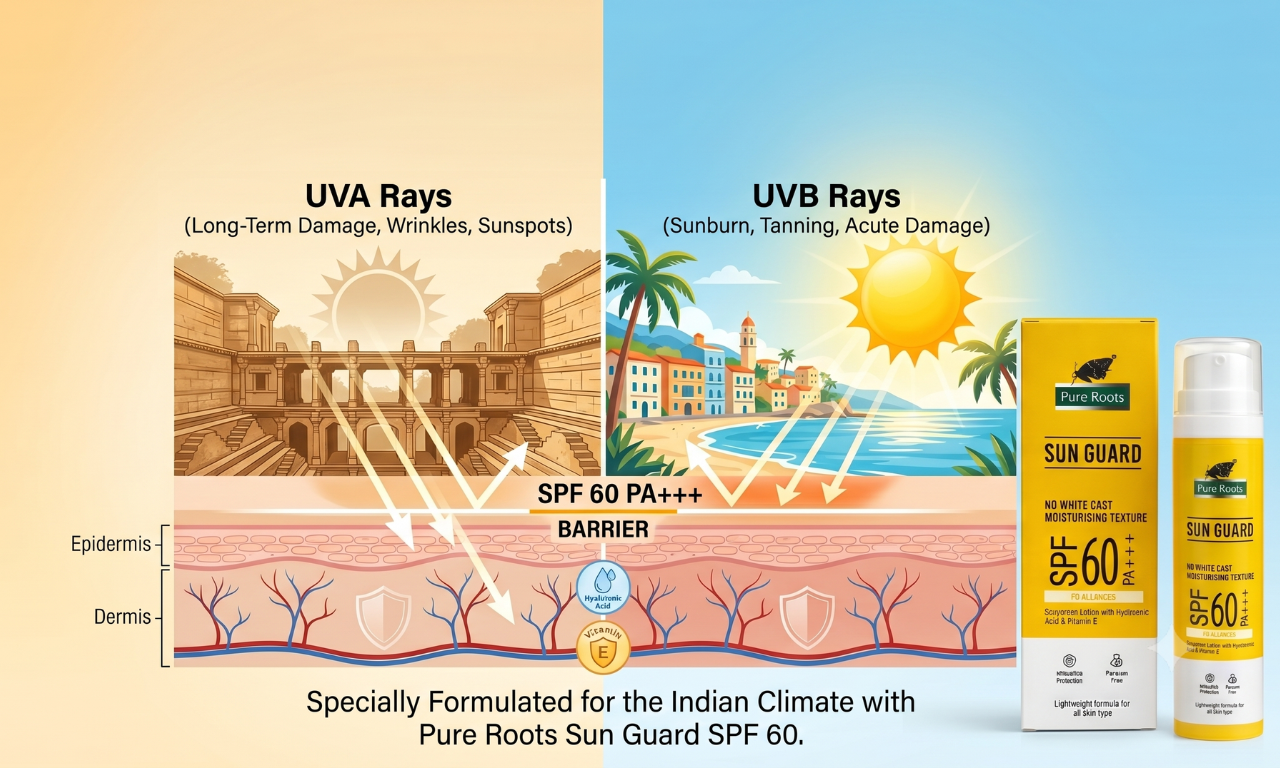
UVA rays make up about 95% of the UV radiation that reaches the Earth’s surface. They operate at a constant intensity during the day, 365 days a year, and penetrate deep into the dermis – the home of collagen – where elastin breaks down, and the DNA damage that leads to aging and pigmentation in the long run occurs. UVA also causes overproduction of melanin, resulting in dark spots, melasma, and post-inflammatory hyperpigmentation – all skin concerns that are disproportionately common for Indian skin tones.
The PA system, developed in Japan and commonly used in Asian skincare markets, measures UVA protection in a way SPF cannot:
PA+ = some UVA protection PA++ = moderate UVA protection PA+++ = high UVA protection PA++++ = very high UVA protection
For the Indian climate and skin tones that are naturally prone to hyperpigmentation, the functional standard is an SPF 60 PA+++ sunscreen. SPF 60 covers UVB completely. PA+++ protects you from the UVA exposure that is quietly driving pigmentation and aging every time you are near a window, driving, or stepping outside.
A sunscreen lotion that carries both ratings, with UVA and UVB protection, isn’t a marketing claim – it’s the real full-spectrum shield your skin needs.
Why the Formulation Is Just as Important as the SPF Number
A SPF 60 PA+++ sunscreen that sits in your drawer because it feels horrible on your skin is not protecting anyone. Formulation bridges the gap between a product that people should use and a product that people do use.
Lightweight sunscreen for Indian conditions: Dense, occlusive sunscreen formulas are really uncomfortable in the first hour of wear, due to the heat and humidity. A lightweight sunscreen, usually a fluid, lotion or gel-cream formula, sits on the skin without creating a heavy film, lets sweat evaporate and does not contribute to the clogged-pore, midday-breakout cycle that makes people give up on sunscreen altogether.
Sunscreen for all skin types: Indian skin is not a monolith. You have people with dry skin, oily skin, combination skin and sensitised skin in the same city block. The right SPF 60 sunscreen lotion for all skin types is one that’s formulated on a non-comedogenic base and does not aggravate oiliness, does not dry out dry skin and does not cause sensitivity. With modern formulation technology, it is possible – only it requires an investment in the formula, not taking shortcuts.
Water-resistant sunscreen for humid and outdoor activities: Water resistance is generally rated at 40-minute or 80-minute resistance when wet. If you commute, work outdoors, exercise or just live in the Mumbai or Chennai monsoon, 80-minute water resistance is the practical minimum. Without it you have little protection after 30 minutes outside.
Correct Application Of SPF 60 – The Indian Scenario
Even the best SPF 60 PA+++ sunscreen, if not applied correctly, offers compromised protection.
Most people use about half of what they actually need. Amount For the face alone, it is a quarter teaspoon — about the size of a 10-rupee coin laid flat. Neck and chest exposed need more product.
Timing: Apply sunscreen 15-20 minutes before you go out in the sun. This window is necessary for chemical UV filters to adhere properly to the skin. Getting in the car or out the door and slapping on sunscreen means the first 15 minutes of outdoor exposure is unprotected.
Reapplication: In Indian conditions, with direct sun, reapplication of sunscreen every 90 minutes to 2 hours is not excessive; it is realistic. For days spent mostly inside, once in the morning is fine unless you’re out for long stretches.
Coverage: Areas that are always under-applied are hairline, ears, back of the neck and hands. UV damage doesn’t care about the edges of where most people think to put sun screen.
Bottom Line for Skin Indian
Objectively, Indian climate is one of the harshest climatic conditions for skin in terms of UV exposure. The high UVI levels, long daylight hours, humidity that breaks down protection faster, and year-round intensity mean that the casual sunscreen habits that suffice in temperate climates are simply not enough here.
SPF 60 PA+++ is not over cautious for daily use in India – it is calibrated to the actual conditions. A lightweight sunscreen in a comfortable lotion or fluid texture, with water resistance and a formula built for all skin types, removes all practical barriers to daily consistent use.
The question is, does Indian skin require this kind of protection. The data will tell you that. The question is: is your current sunscreen really doing its job?
Pure Roots Herbals SPF 60 Sunscreen Lotion is formulated to provide that – broad spectrum UVA and UVB protection in a light, non-greasy formulation designed to endure Indian daily conditions. Check to see if your current sunscreen is rated PA+++ If it is not there then you have a major gap in your protection.
FAQs (Frequently Asked Questions)
Q1 Is SPF 60 sunscreen necessary for daily use or SPF 30 is enough in India?
For most Indian climates, SPF 30 is the minimum and not the norm. Given that India experiences high UV index readings regularly, and that real-world usage typically provides 25 to 75% of the rated protection due to incomplete coverage, SPF 60 offers a practical margin that SPF 30 does not. If you spend all day inside and rarely see a window, SPF 30 to 50 is workable. SPF 60 PA+++ sunscreen is the standard for daily use for anyone with real outdoor exposure, whether commuting or living in high-UV cities.
Q2. What is PA+++ and why is it not listed on all sunscreens?
PA+++ is a UVA protection rating system that originated in Japan, but is now standard throughout much of Asia. It offers high UVA protection. It’s not on every sunscreen because the SPF system (which measures only UVB) was developed for Western markets where standards for UVA were historically less regulated. A lot of international brands of sunscreen do not have a PA rating, meaning they have not certified their UVA protection by this standard. A sunscreen lotion with both UVA and UVB protection and a PA+++ or PA++++ rating is a must-buy for Indian skin as it is highly sensitive to UVA because of high melanin.
Q3. Do I need to re-apply a fresh coat of water-resistant sunscreen after swimming or sweating?
Yes, always. The 40 minutes or 80 minutes water resistance ratings are the time frames for which the protection is sustained when the watch is subjected to continuous water in a controlled test. The practical window is narrower in real life conditions involving towelling, sweating and movement. You need to reapply after significant sweating or water exposure. Water resistant sunscreen is more durable under moisture, not water proof.
Q4. Is a light SPF 60 sunscreen actually non-greasy and good for oily skin?
Yes – and that’s where we’ve seen a lot of progress in formulation technology in the last few years. Older high-SPF sunscreens were based on heavy emollients that were used to stabilize the UV filters, making them occlusive and greasy. Lightweight film forming agents, silica based mattifiers and water gel textures are now used in modern SPF 60 sunscreen lotion formulations, providing high protection without the grease. A good lightweight sunscreen for all skin types won’t add shine or clog pores – the problem is that many cheap or outdated formulas haven’t caught up with this standard yet.